
Hi Professor Navara,
Welcome to my final learning journal blog post.
I would first like to begin by thanking you for being a fantastic professor throughout this semester. I think you offered a great balance between discussant and critique during our seminars, and you knew when to take a step back and let the rest of the class talk.
During our first seminar, we tossed around different ideas of evil and what we thought evil entailed. We found that there are three realms that determine if an act is evil, which include the eye of the beholder, the individual, and the society in which the act occurs. As a class, we thought that evil was something that was done with the intent of hurting someone or violating someone’s rights. This was usually discussed in the context of rape or murder, and I think this is because these are acts we don’t imagine ourselves committing. With my background in law courses, I started to mentally file our discussions into a mens rea and an actus reus – the criminal intent and the criminal act. As I took notes in our discussions, my notes looked more like scribbles of arrows and thought bubbles than actual class notes.
Unfortunately, this semester taught me a little bit more than I bargained for when I suddenly lost one of my best friends in the beginning of March in a fatal car accident. This really solidified my idea that evil doesn’t have to have an intention behind it, as (to our knowledge) the man who hit my best friend did not intend to kill her. This removed the mens rea part of my definition. It also taught me that evil acts have a lot of repercussions, and in the case of my best friend, these repercussions were mainly emotional. The evil doesn’t stop at the event, and I don’t think that we covered that in our class. We never spoke about the fact that the effects of evil ripple out beyond the act.
I also learned that there are more forms of evil than I initially thought. When we started the class, the conversations mostly revolved around rape and murder because those are the crimes that come to mind when we think “evil”. After listening to all of the presentations over the semester and reading everyone’s blogs, I truly saw that there are so many variations of evil. Among my favourites were the presentation on corporate evil, the presentation on the death penalty, and the presentation on the Blue Code of Silence. It really showed me that evil comes in a lot of shapes and forms and that sometimes something as simple as keeping a secret (blue code of silence) is evil. Sometimes evil can be as simple as not doing anything, and just following along, like in a cult situation.
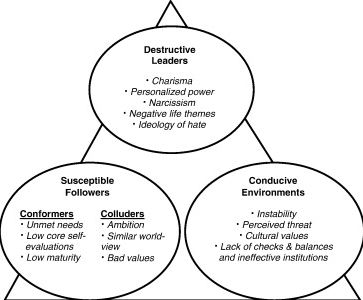
The most important thing to remember is that a lot of things happen in constellation to equal evil. It is not one isolated event or condition that creates evil. While psychopathy is something that increases the likelihood of things that we consider evil, it does not always equal evil. Closer to the beginning of the course when we were reading the assigned books about evil, I think that showed the class that evil is often a social circumstance. In the example of the Nazi’s, we saw that those who were killing the Jewish individuals didn’t often have a choice in the matter. It really demonstrates that evil isn’t solely a psychological thing, it’s an interaction between a bunch of different factors.
So, here I am, trying to come up with a definition that ties up what I’ve learned thus far, and I think I have more questions than I do answers. My questions are more informed, and I have more specific questions, but I’m still left wondering about quite a lot. In summary, if I had to create one single definition of evil, I would say that an evil situation is a constellation of circumstances that causes an event that greatly contradicts a society’s morality. These circumstances can include psychological illness, social arguments, a reward for evil, or escalation, for example. Evil has a lot of moving parts, it is not just one thing. It is composed of the perpetrator’s actions, how the victim reacts, and how the society in which it occurs perceives the act.

















 Jessica's Evil Psychology