
This week our conversation started with a very interesting presentation by a classmate about corporate evil, which then bled into a conversation about The Lucifer Effect by Philip Zimbardo (Zimbardo, 2007). In a nutshell, the presentation spoke about how certain leaders of corporations make “evil” decisions which are then followed by the rest of the company/corporation. The presentation covered many reasons for these evil decisions, such as ego-depletion, but something else stuck out to me.
In both the presentation and The Lucifer Effect, there was a leader who was making awful decisions, but there were also followers who did not question the leader. This situation is parallel to the bystander effect, where people participate in activities or fail to stand up to the leader, allowing the evil situation to continue. We saw this in The Lucifer Effect which describes the Stanford Prison Experiment, where there were a select few correctional officers who were particularly harsh on the prisoners, and there were others who failed to say anything and followed along (Zimbardo, 2007). I think both situations are equally bad. While one party is instigating the harmful behaviour, and the other is allowing the behaviour to continue.
I related this issue to an episode of a podcast that I listened to earlier in the week. The podcast is called Crime Junkie, and they discuss murder and disappearance cases in weekly episodes. This week, the victim was a young black girl who disappeared years ago and is still missing, Relisha Rudd. She was only 8 years old when she went missing and it took 18 days for anyone to raise concern that she was missing! Even when it was realized that Relisha was missing, search efforts were few and far between, and she has yet to be found.

While I was listening to it, I kept wondering why the police never tried to look for Relisha. The lead detective and constable were the ones that failed to organize searches, but Relisha’s mom, her grandmother, her teachers, and the other police officers all failed to intervene when there was clearly a reason for intervention.
I found an interesting blog post that discussed The Toxic Triangle, which is composed of destructive leaders, susceptible followers and conductive environments (Padilla, Hogan, & Kaiser, 2007). I focused on the part of the article where susceptible followers were discussed, since that was the focus of our class discussion. The authors suggest that followers are so willing to obey a leader because they value security and group membership above all else. Along with this, we have a natural tendency to imitate higher-status individuals and to follow group norms, even if it contradicts our morals (Padilla et al., 2007). The authors goes on to say that there are two types of followers: conformers and colluders. Conformers comply with the leader’s destructive behaviour (like in Relisha’s case), and colluders actively participate in the leader’s agenda (like in the Stanford Prison Experiment) (Padilla, 2007). This made a lot of sense to me, and provided me with a little more clarity.
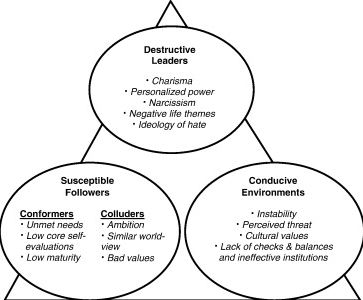
I think of all of this is understandable. People just want to fit into a group and to follow behind powerful leaders. This becomes problematic when the leaders are making immoral decisions and the followers are clouded by their need to conform to a group.
To summarize, leaders have an advantage as followers have a tendency to comply to their demands. This can be disastrous when the leader has a lack of morals and places their own needs above others. We saw this in Zimbardo’s book, our class presentation, and the Relisha Rudd case. These actions were explained by Padilla, Hogan and Kaiser, who discussed the triad of toxicity, and how followers can succumb to evil leaders.
References
Flowers, A., & Prawat, B. (Producer). (2020, February 17). Crime Junkie [Audio podcast]. https://crimejunkiepodcast.com/missing-relisha-rudd-unique-harris/
Padilla, A., Hogan, R., & Kaiser, R. (2007). The toxic triangle: Destructive leaders, susceptible followers, and conducive environments. The Leadership Quarterly, 18(3), 176-194.
Zimbardo, P. (2007). The Lucifer Effect. New York, NY: Random House.
 Jessica's Evil Psychology
Hi Jessica!
Thank you for bringing attention to the case of Relisha Rudd: it’s certainly a very poignant example of how the corruption of leaders can lead to very tragic outcomes. I believe it also may be a case of intersectionality, as Relisha was a young Black girl and her race and gender may have unconsciously influenced the lead detective and constable to take her case less seriously than if she was White or a male. Furthermore, the overall direction of the case seems to follow the Toxic Triangle you mention. As the lead detective and constable weren’t taking her case seriously, it’s unlikely their subordinates would have started to take it seriously on their own if they shared similar values; and her grandmother and mother may have been unconsciously impacted by systemic racism and suffered from the low self-evaluations or unmet needs that would have rendered them conformers. Finally, the environment was likely conducive to the propagation of evil, as police departments are often notorious for having racial biases as well as having internal cultures that promote obedience to authority. Very thought-provoking and interesting post!
LikeLike
Hi Jessica!
The organization of the toxic triangle makes a lot of sense. The combination of leaders with bad morals, people willing to follow this person, and the right type of environment make for some harmful actions. However, it’s interesting that they divided followers into two categories. The typical view for me of a follower is the conformer type with low core-self evaluations, but the idea of the colluder is what really got me. The colluders follow because they have lots of ambition. This makes me wonder where I would be placed in the toxic triangle diagram, and makes me realize that presumably as a follower, I would be capable of causing evil harm to people, which is a scary thought.
LikeLike
The content you used was very interesting and you presented it very well, I think the 3rd point of the triangle can also be applied to at least the Stanford Prison Experiment because the environment had instability based on the lack of direction and rules that were there before the guards made their own. Do you agree? Do you think something from the conducive environment point can be applied to the missing person as well?
LikeLike
Hi Jessica,
I felt the exact same way in my blog post! how funny! any who… I think what Madisonmjd has to say is interesting, and I agree with their point as well about the triangle also being applied to the Stanford Prison Experiment due to the lack of rules and directions!
LikeLike